the sound of the sun, synaethesia, and semantic web

This slideshow requires JavaScript.


(( sound ))

Today’s post is brought to you by the letter “S” and the number “2”

This past Monday we held our second official “sameAs” at the Old Crown in Bloomsbury. The event is the brainchild of my dear friend Matt and I, aiming to bring together the fascinating folks from our adventures (both work related and personal) and have stimulating conversation. Add to that a pub atmosphere, a flexible format and brilliant minds, wind up and let it go. The results and response have been absolutely incredible thus far.

For this event, we decided to take a bit of a gamble and toss a non-traditional theme into the mix:  sound. A day of flipping through our mental rolodexes and we had our speakers – each coming from wildly different backgrounds, industries, trainings, but all stitched together by a fascination with sound and how we can manipulate, capture, transform and analyse it. Personally, this event really echoed our initial aim with wanting to start this event series — bringing together folks who otherwise would not likely be under the same roof, drawing in those from outside the usual science and technology circles and involving artists, game developers, sound engineers, digital media gurus, etc. For me, this is *exactly* why we started this project.

A quick recap of the night, touching on some of the main points (videos to come, which I do hope you take the time to check out):

We had Nick Ryan and Paul Bennun kick off the night – Nick engaging the audience in a few exercises to test their knowledge of what “sound” is, this all encompassing concept that surrounds us and provides the daily soundtrack to our lives. Nick is a composer / sound designer friend and a synaesthete, realizing this a number of years back when he felt the texture of a garment and automatically transfered that into sound and color. He provided a  background on some of his experiences with his synaethesia, some of his work based off of that (which was absolutely stunning), and even explained things to the newbies in the room (//raises hand) what Head Related Transfer Function was. He then handed over the floor to friend and colleague Paul Bennun of Somethin’ Else, whom he’s been working with to create a 3-D audio experience in a videogame medium.

Paul heads up Somethin’ Else, and has been pouring his efforts (and those of his team, including Nick and the lovely Tassos Stevens, who also joined us for the night) into a labor of love project called “Papa Sangre“. It’s a game with no video – based solely on auditory response, utilizing the 3-D audio concept mentioned above. For a better idea of what I’m going on about, dust off those headphones, and watch this sneak peek. It’ll blow your mind.

From the world of sound design and gaming, we moved to big data and structural analysis. We were delighted to have Dave de Roure join us from Oxford, where he heads the e-Research Centre. Dave’s latest fascination is with a project he’s involved with (with perhaps the best acronym ever) – SALAMI (Structural Analysis of Large Music Information). It’s computational musicology at it’s finest, and even included mentions of Ted Nelson and the Linked Data movement  / Semantic Web. How I love SPARQL mentions 🙂 (happy inner geek, w00t). Bonus points to Dave for tying his presentation so nicely to the first sameAs on the Web, as well.

We concluded the night with the lovely Honor Harger, director of Lighthouse and co-founder of Radioqualia. I first saw Honor this past summer at an event dedicated to the power of the sun, held at the BFI to celebrate the birthday of the Royal Society. She showcased some of her team’s experiments in “radio astronomy” – taking the electromagenetic frequencies of the solar system and transforming them into a form able to be broadcast via a radio station.

She also showed a video by Semiconductor called “Black Rain” – an artistic interpretation based on the raw data collected from satellites. An absolutely riveting and stunning piece of film to watch, that leaves me completely awestruck every time. Here’s a snippet:

Many thanks again to all of you who made it out. I hope you found the night as engaging as we did. 🙂 Videos to come in the next few days, and do stay tuned for more on upcoming sameAs events. For December, we will be taking a break for our usual speaker formats, and heading the The Book Club in Shoreditch for a specially created sameAs sci/tech pub quiz. Trust me, you won’t want to miss this.
more on happiness as a business model

I’m starting to think that John is on to something – or else elated that there are other likeminded entrepreneurs out there.

Spotted this morning on TechCrunch TV, an interview with Tony Hseih, the CEO of Zappos on “happiness as a business model”. He talks about how things like the culture of the office and hiring as a process (the good and the bad) can really lend to internal happiness at a company. There are quite a few parallels to John’s talk from the first sameAs about being in the customer happiness business, but he takes it one step further, making one key point that I personally try to live each day (6:35 mark) :

Make sure whatever you’re doing, you’re passionate about doing it.

(I’m going to bold that even to hopefully help drive it home some more 🙂 )

But really, I can’t emphasise enough how important that is. Whether it’s customer service, disease research, government, science / tech, being an educator, you name it – it’s that passion that will get you through the tough times, and it’ll rub off onto your colleagues and those you interface with. And that is ultimately a very, *very* good thing.

Sidenote – apparently members of the Zappos team are on a 3 month bus tour promoting this idea of happiness as a business model. Nifty.


being in the ‘customer happiness’ business

Last but *certainly* not least, the final talk from our inaugural sameAs on the Web. We were thrilled to be joined by friend and former colleague John Buckman – digital entrepreneur, man behind Magnatune and BookMooch, and Chairman of the Electronic Frontier Foundation. I came to know John when I moved to London, funnily enough after both of us had moved on from Creative Commons.

Here he is speaking on what it’s like to conduct business in the networked world and the importance of patronage – as he so aptly puts it “being in the ‘customer happiness’ business”. I highly encourage you take a look.

Note: The next sameAs is coming up next Monday, 22 Nov at the Old Crown in Bloomsbury. The theme is ‘sound‘, the speaker list is top-notch, and well – we’re wicked excited. You should be too. 🙂

Thanks again to Steve Allen for the video.

more on sameAs, citizen science, and a ‘data bonanza’

Serving you up another sameAs video this Thursday afternoon, again compliments of Steve Allen. I know, so much goodness for a Thursday. It’s *almost* too much. Like too much chocolate cake.

(I take that back – one can never have too much cake. M’mm cake.)

Now available, our second speaker from sameAs – Arfon Smith, astronomer extraordinaire, and citizen scientist. Here he is speaking about a project he’s a part of called Zooniverse (GalaxyZoo being a part of that), an effort to crowdsource problems such as classification of galaxies by involving members of the general (non-astronomer or even scientific) public. For more on the project (beyond, the video, of course), check out Ars Technica’s latest on the effort.

And many thanks again to Arf for joining us. John Buckman’s talk, coming soon.

the first sameAs, david byrne, and the web

This slideshow requires JavaScript.

I’ve been on quite a Talking Heads kick this week – quite possibly prompted by the first sameAs this past Monday evening  (or quite possibly because I just *really* love “Stop Making Sense” 😉 )

//cue “Once in a Lifetime”

Right, back to the event. First off, an enormous thank you to all of you lovely folks who made it out for our inaugural event (and special thanks to Carolina and Steve for their fine media additions). The first video of David Weinberger’s talk is now up, thanks to the fine Steve Allen – with Arfon’s and John’s to come. And if it’s not clear from the fact that I’m in some of these photos ;), many thanks to Carolina Ödman for her stunning black and white photography (all images featured here under a CC-BY-SA-2.0 licence, full set available here, and flickr group here.) We’re really grateful to you both for helping us capture the event.

Given some of the back channel response during but largely after the event, I’d venture a guess that the talks struck exactly the right note:  informal, provocative, with a bit of humor wedged in to keep the audience on their toes. Personally some of the gems for me included David’s quip that “Skulls don’t scale, networks do”, Arfon’s data comparison to the Oprah viewing audience, and John’s eloquent way of describing his main task at Magnatune of “selling customer happiness”. There is quite a lot more to add to that, and I hope you check out the videos and podcasts when those become available to see for yourselves. I’ll be posting links to them here as they’re posted.

And do take a look through some of the images of the night. Many of you will spot some familiar faces, and hopefully some new ones, as well.

Thanks again to all of you who joined in person or sent support through the interwebs. And mark your calendars – the next sameAs is scheduled for 22 November (we’re putting a bit more fun into Mondays). More to come at sameas.us.

upcoming web geekery in london

I hinted at a new side project in my last post. Tomorrow night is the first night of that side project – a new kind of science and technology meetup here in London we’ve decided to call “sameAs”*. The lovely Matt Wood joins me as co-host and the token tech-savvy half of the organising team. It kicks off at 7 pm tomorrow night at the Coach & Horses in Clerkenwell, and we hope you can join us. We’ll be hearing from three exemplary folks from three very different sectors, all stitched together with the common fascination with the Web and how it can transform the way we process information, collaborate and share.

Here’s a look at the speakers:

* David Weinberger: Fellow at the Berkman Center at Harvard, library innovator, and author (“Everything is Miscellaneous”, “The Cluetrain Manifesto” to name a few)

* Arfon Smith: astronomer, citizen scientist / crowdsourcer of galaxies and other things

* John Buckman: Digital Entrepreneur (of books and music), EFF cardholder

Admission is free, but space is limited. I hope you can make it out, and stay tuned for future events. Our hope is to have these monthly, with varying formats and a theme that loosely weaves together conversation. For more info, visit our website or follow us a @same_as. We even have a facebook page and posting on lanyrd (hey now, all the cool kids are doing it).

* bonus points if you get the reference 😉

sunday morning linkfest

(perhaps this will help with my tab-overload problem.)

Here are this week’s posts of interest in the world of KT web-surfing.

To ease into your Sunday morning, pretty data visualization. It makes the world go ’round, really. See some here and here.

Over on dataists, Hilary Mason and Chris Wiggins list 5 areas that data scientists should be comfortable in (and IMHO, are spot on). – A Taxonomy of Data Science

To follow on that, OUseful.Info asks the question on many of our minds … what are we going to do with all this data?

Jim Caryl writes about molecular / plasmid jigsaws over on Nature blogs, and why it’s important to list full sequences and provide comprehensive instructions, well, to make his life (and many others in his research space) much easier. Take one look at the image and you’ll understand why.

If you haven’t read Mike Loukides’ most excellent post “What is Data Science” on O’Reilly Radar already. Go. Go now. I may be a bit late in posting, but it doesn’t get much better than that.

Don Tapscott and Anthony Williams – coiners of the term “Wikinomics” – are revisiting the mantra laid out in their 2006 work, now adding “macro” to the title, and focusing more on the power of monetary incentives and profits. Interesting use cases on entrepreneurial approaches to enacting change in the public sector from the US to Kenya, Palestine to Estonia.

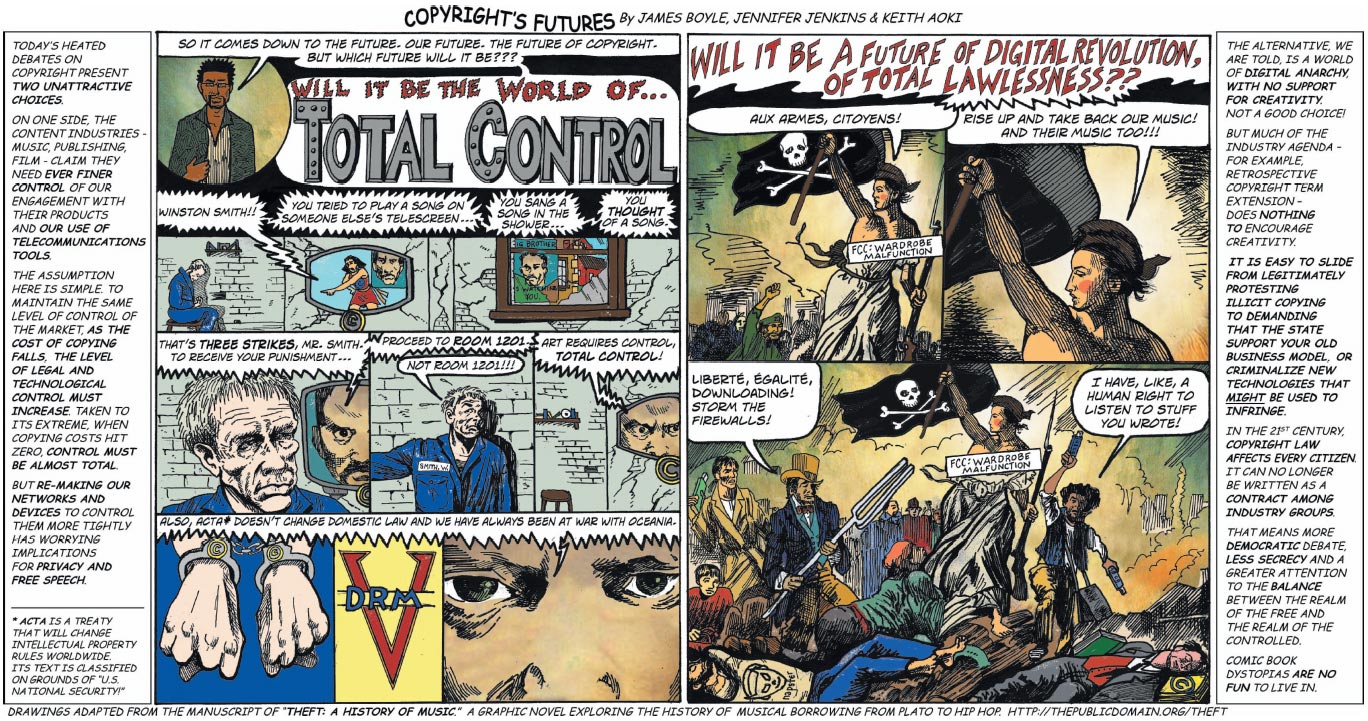
From the Center for the Study of the Public Domain at Duke – a brilliant new comic on Copyright’s Futures, and Pam Samuelson from Berkeley writes about how copyright law needs a digital-age upgrade (and rightly so). (HT @thepublicdomain)

Girl Power — All girl robotics team shows the boys what’s what. More on the Fe26 maidens. (love this).

For a complete sidestep from online collaboration and data science, former Globie Francie Latour has a phenomenal piece on the hidden history of New England, and its complicated relationship with slavery. Lo and behold, the North wasn’t so innocent.

And that’s all for this week’s installment of random linkage. Until next week.

** Also, stay tuned for announcement of a new project, Londoners. October 25. Mark your calendars.

back to old stomping grounds

I swear I didn’t get deported. Travelling back so soon after relocating that my shipped belongings have yet to arrive raises some eyebrows. Nevertheless, I boarded a plane to Boston for the week. The reason? EmTech at MIT the 21-23, and two days of meetings / catch ups with interesting folk of past, present and future.

This post isn’t to get into the nitty gritty details of last week’s highlights — that’s saved for a day less soggy with  redeye induced jetlag. For now, a few photo reminders of my beautiful Boston home, from old office space and the walk to my old apartment (not a “flat” there, sorry) to a friend’s Rubix cube creation. Full set can be found here.

Needless to say, it was wonderful to be back on old stomping grounds with familiar faces of all sorts (and new, as well). The exhaustion is massive, and Boston, you shall be missed, but it’s good to be home.

utilizing games to battle neurodegenerative disease

HT to Lesa Mitchell at the Kauffman Foundation for this one.

The Myelin Repair Foundation, in partnership with the Robert Wood Johnson Foundation, Institute for the Future and a number of others, has posted a truly inspiring challenge to the broader community to battle neurodegenerative disease and the inefficiencies of the system. The means? An online game called “Breakthroughs to Cures“, where the year is 2020, a new neurodegenerative disease is sweeping across the masses, with no cure, no outward symptoms, and a seven to 10 year survival rate. The disease (a made up one for the sake of the game) is said to affect 100 million in the US alone, and the President is asking for the public to rally together and brainstorm what works and doesn’t work with the existing system, and how to accelerate the pace of research to stop the widespread contamination and cure the disease.

If you suspend disbelief for a second and leave your scifi opinions at the door, this is really inspiring – especially if you’ve ever had a loved one who’s suffered from a neurodegenerative disease (I have). The resources are slim, if any; the knowledge is scant and locked away in silos; and the outlook is often dim save a few measures known to help slightly slow the decreasing quality of life of most patients. I spent quite a bit of time in my previous job working with various disease research foundations and “venture philanthropy” groups, and I have to say, if this helps push the envelope even the tiniest bit and brings attention to the broader inefficiencies of neurodegenerative disease research, then I’m 100% behind it.

The game goes live on October 7th and lasts 24 hours. Click here for more.

for the mildly homesick out there

A dear friend back in Rochester passed this along with a note saying “it’ll help you remember home”. Having recently shipped off from the states to start a new, pithier life in the UK chock full of british slang and mannerisms, this sort of message makes its way through the wire pretty frequently. It’s the care-package stage, really, loved ones trying to ease the transition but also make sure my mental snapshots of “home” don’t fade.

I didn’t get around to checking out what my friend sent. It’s the new Arcade Fire HTML5 video, and by god, it’s brilliant. If you’re even slightly homesick, or even just want a tinge of nostalgia to go with your cup of coffee and biscuits, do check it out. You’ll be glad you did.